Project Hail Mary: Greig Fraser, ASC, ACS Explains the Film's "Scooby-Doo Effect"
The cinematographer used a mis-timed Arri 435 shutter and a dual-filmout process to help bridge the film's two visual worlds.
Some films might transition between aspect ratios with a hard cut: In one frame, the picture might be in 2.39:1, and the next it's in 1.85:1 or taller. But on Project Hail Mary, cinematographer Greig Fraser, ASC, ACS and directors Phil Lord and Christopher Miller sought a more fluid shift in formats — a goal made possible by their embrace of what Fraser calls "the Scooby-Doo Effect."
The idea was sparked by a phone call Fraser received from Lord during postproduction, as the filmmakers were shaping Project Hail Mary's flashback structure. Speaking with American Cinematographer for the magazine's April '26 issue, Fraser recalls, "[Phil] asked, 'Remember in 1980s TV and cartoons when they talked about the event that was about to be flashed to, and there would be a kind of wiggle to the image transitioning to the flashback?' And I said, 'Yeah, I know exactly what you're talking about. The Scooby-Doo effect.'"
To create these transitions, Fraser notes that he drew upon a technique used by Janusz Kamiński on Saving Private Ryan (AC Aug. '98): shooting with a mis-timed shutter to create image streaking. (In our original story on that production, Kamiński says he borrowed the trick from Douglas Milsome, ASC, BSC, who implemented it on Full Metal Jacket, which was explored in AC Sept. '87.) However, Fraser notes that "we couldn’t really do that as a post effect, so I suggested that we take [our] memory sequences and reshoot them off a monitor onto film with [the] mis-timed shutter." The cinematographer ran the already-finished Earth flashback sequences off of a high-quality 4K monitor and rephotographed them onto film using the Arri 435, with the camera's shutter phasing intentionally offset. The filmmakers then used the resulting image streak to transition between the full Imax "reality" of the spaceship and the wider "memory" of Earth.
More on the Mis-Timed Shutter Technique:
Janusz Kamiński Shoots Steven Spielberg's Saving Private Ryan
Douglas Milsome, ASC, BSC Photographs Stanley Kubrick's Full Metal Jacket
Project Hail Mary's filmout process further reinforced the film's distinction between these "reality" and "memory" worlds. Fraser and colorist Dave Cole of FotoKem, an ASC associate member and one of the cinematographer's longtime collaborators, used two separate Kodak stocks. The spaceship and space-exterior footage was output to 5203, a 50-ISO camera negative, for a grittier texture that helped convey Ryland Grace's (Ryan Gosling) isolation. The Earth sequences went to 5254 — which is rated at ISO 1, with silver retention applied — to help create smoother, cleaner images that evoke the warmth of the hero's nostalgia for life back home.
"This kind of filmout technique isn't really about grain," Cole notes. "It's about everything else that the photochemical process offers: non-linear density across the frame, silver retention, highlights blooming, an imperfect steadiness or slight gate weave — all of these things add in the organic quality of film."
Unit stills by Jonathan Olley and the filmmakers. Images courtesy of Amazon MGM Studios.
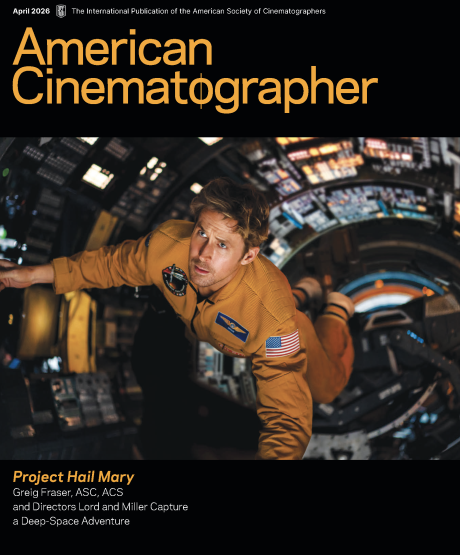
Discover more on the making of Project Hail Mary in American Cinematographer's April 2026 issue, with in-depth coverage by AC virtual production editor Noah Kadner and additional reporting by ASC associate member Jay Holben, AC's technical editor and author of the magazine's Shot Craft column.
For full access to our archive, which includes more than 105 years of essential motion-picture production coverage, become a subscriber today.