Hard Light in Black-and-White: Shooting The Stranger
Cinematographer Manu Dacosse, SBC conjures harsh, hot atmosphere for director François Ozon's film, which offers a monochromatic vision of Albert Camus' classic novel.
The French film The Stranger, directed by François Ozon and shot by Manu Dacosse, SBC, is all about oppressive heat. Set in Algeria in the 1930s, the story follows a nihilistic Frenchman, Meursault (Benjamin Voison), who compulsively murders an Arab (Abderrahmane Dehkani). Re-reading Albert Camus’ novel, Dacosse was impressed by Camus’ constant emphasis on Algeria’s harsh light and heat, and he thought “that’s really something that could come through in the movie.”
Finding the Film's Look — Why Black-and-White
While shooting location stills in Morocco during prep, Dacosse experimented with different looks, and he knew he’d found the aesthetic for The Stranger when he saw the shots in black-and-white. “François said that all of the archives from that period he had seen on television depict Algeria in black-and-white," the cinematographer says. "And then there was the fact that the [Luchino] Visconti [1967 adaptation] was shot in color. We wanted something different.”

Dacosse had shot black-and-white as a still photographer early in his career, but he had never shot a film that way. For reference, he and Ozon favored the recent TV series Ripley, shot by Robert Elswit, ASC (see AC July ’24), and the Holocaust drama Schindler’s List, shot by Janusz Kamiński (AC Jan. ’94). “We talked a lot about Ripley, and I'm a huge fan of Kamiński and how they use hard light in [Schindler's List] — a lot of highlights and really dark black. I started [my career] shooting film, and at the start of digital, soft light was better, but now I’m starting to love hard light again.”
Explore the Black-and-White Cinematography That Influenced Manu Dacosse, SBC's Approach to The Stranger:
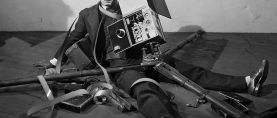
Janusz Kamiński Brings Black-and-White's Somber Palette to Steven Spielberg's Schindler's List
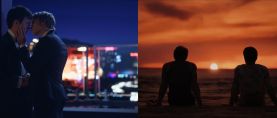
Robert Elswit, ASC Shoots Ripley in Elegant Black-and-White
Opting For the Alexa 35
A longtime user of the Arri Alexa Mini, Dacosse decided to use the Alexa 35 for the first time because of its rendering of highlights. But it was an adjustment. “When shooting digitally, I always try to protect the highlights, and with the Alexa 35, I knew that I would always be able to capture detail in the highlights," he says. "In the beginning, I had to think differently, because I often underexpose the Alexa Mini to protect the highlights — whereas with the Alexa 35, you have to overexpose because there’s so much detail in the highlights. So, every day, I used DaVinci Resolve on my computer to check some shots because I didn't know the camera well. And I was really surprised with the highlights. Sometimes I overexposed one stop and couldn't get back. It was like film. Once I got used to [one stop], it was great, because I didn't have to worry about the highlights anymore.”
Controlling the Weather
Conveying time of day monochromatically presented some challenges, and the abundance of cloudy days in Morocco led the filmmakers to position an Arri M90 on the roof opposite the set depicting Meursault's apartment. "This was all filmed on a small street in the center of Tangiers," Dacosse notes. "At the beginning of the shoot, the weather changed frequently, but toward the end it was more steady. We used the M90 because there was no space for a cherry picker, and it provided hard sidelight in the apartment."
Lens Choices
Ozon serves as his own camera operator and prefers zoom lenses so he doesn't have to spend time changing out lenses for different shots. For most of The Stranger, he used an Angénieux Optimo 17-80mm, “an old glass that's not very sharp and has a nice look,” Dacosse says. For Steadicam shots, including the one leading up to the murder, they used Cooke S4 primes. "Guillaume Quilichini was our Steadicam operator," the cinematographer adds, "and we used the 25mm, 35mm and 50mm S4s on the Steadicam."

Static Shots For an Observational Opening
Dacosse encouraged Ozon to use more static shots than usual, noting that much of the story is about simply observing Meursault in his environment. The cinematographer points to the opening 20 minutes as an example. “It’s the moment we’re establishing the look, and we stay really static. I have light from the windows [but] didn't put any smoke. It's true to the period — at that time, there was nothing to do. Now people are always busy. But then, you wake up, you make breakfast, you look out the window. And Benjamin is really easy on the eyes … he knows the light's good and understands he has to look to the window if he wants to be seen, and avoid the light if not. He really understands the lens, too — that with a wide angle, you don't come too close.”
Shooting Key Sequences
Daytime scenes were shot on a set built in a garage, and Dacosse requested small windows so he could play with hard light by shining an Arri M18 through them. For nighttime scenes, however — such as one in which Meursault stays overnight beside his mother's coffin — there was only a single lightbulb above Voisin, shining brightly like a tiny sun.
Later, when Meursault reunites with former girlfriend Marie (Rebecca Marder) for a swimming sequence at sea, there was a happy accident. Dacosse explains, “When we filmed that scene, the sun was right behind the actors, and we had an ND6 filter in the mattebox which created double reflection for a moment. It was really a perfect moment, because the sun was at 90 degrees and Benjamin looked in the perfect direction toward the camera. François really loved the effect, so we re-created it."

Capturing the murder, which occurs on the beach in broad daylight, was complicated by the need to navigate the tides each day. “We had to work really fast from 10 a.m. to 2 p.m. to get the scene,” the cinematographer recalls. “We wanted to play with a lot of things, like really high and low angles, and a warm effect where you burn a gas canister to slightly distort the [image]. And we pushed a bit in the VFX to have more brightness. Then we played with a small mirror and the sun. And the sun was directly overhead, really pushed. It had to be violent.

"To achieve a close-up of the blade [used in the murder], we placed a mirror to capture the light reflection, and then pushed the highlights in postproduction," Dacosse continues. "To create the glare from the blade on Benjamin, we used a tiny mirror to cast a spot of light onto Meursault's face. The inspiration for this heat effect came from Raging Bull. The prop was a tray filled with sand. Alcohol was poured onto the sand, and when it burned, it created ripples in front of the camera."
Another striking scene involves Meursault and the chaplain (Swann Arlaud) in a prison cell. “That scene was about finding the right compositions, the static shots,” Dacosse says. “It was the first day of shooting, and we had two days in France during March, when it was very cold. François wanted to do it as a long take, but in the end, we just cut because it was really too complex. But the lighting idea was simple: To ensure consistent lighting, we set up two Arri M40s on a cherrypicker outside the window. Finding the right height was important to ensure that the direct light reached as far into the room as possible.


“There’s a lot going on between the characters in that scene — it’s about faith," Dacosse continues. "We had one problem when shooting it: We used haze to create a shaft of light, but when the two actors approach the small window, smoke could be seen escaping through it. So, we placed small panes of glass there, to prevent the smoke from going outside. Normally I use a lot of haze when I'm shooting, but I thought maybe for black-and-white, haze is not so good all the time. But in the middle of this scene, I had to add just a bit because I love it!”
Dacosse received a César Award nomination for his work on The Stranger.
Images courtesy of Music Box Films and the filmmakers.
Tech Specs
Aspect Ratio | 1.66:1
Cameras | Arri Alexa 35
Lenses | Angénieux 17-80mm zooms, Angénieux HR 25-250mm, Cooke S4