Deep Cover: The Departed
Michael Ballhaus, ASC and gaffer Andy Day illuminate their work on The Departed, a crime drama that pits Massachusetts State Police against a brutal Irish mob.
This in-depth look at the making of The Departed first appeared in American Cinematographer's October 2006 issue. For full access to our archive, which includes more than 105 years of essential motion-picture production coverage, become a subscriber today.
In the gangster genre, Martin Scorsese has few rivals. As the director of Mean Streets, Goodfellas, Casino and Gangs of New York, Scorsese is the reigning capo di tutti capi, or “boss of all bosses” — especially now that Francis Ford Coppola, Don of the Godfather trilogy, has abandoned “family business.” Of course, no mob boss can function without a good adviser, or consigliere, and Scorsese has long benefited from his collaboration with cinematographer Michael Ballhaus, ASC, who has shot seven films for him, including GoodFellas and Gangs.
Ironically, Ballhaus says he abhors violence, onscreen or off, and says he is only willing to shoot such scenes for Scorsese out of respect for his good friend’s cinematic prowess. “Marty is my favorite director because he’s the most visual filmmaker I’ve worked with in America, but if you have a philosophy about violence, you’d better put it aside when you work with him,” he says with a rueful laugh. “In general, I’m not a big fan of violence, but in Marty’s case, I accept it. If I had an offer from a different director to shoot this type of movie, I might not do it. Sometimes you can feel hurt or insulted by the violence, but the world Marty is portraying is violent, and the way he presents those scenes tells you something about the characters. So I see a reason for it in terms of the story.”
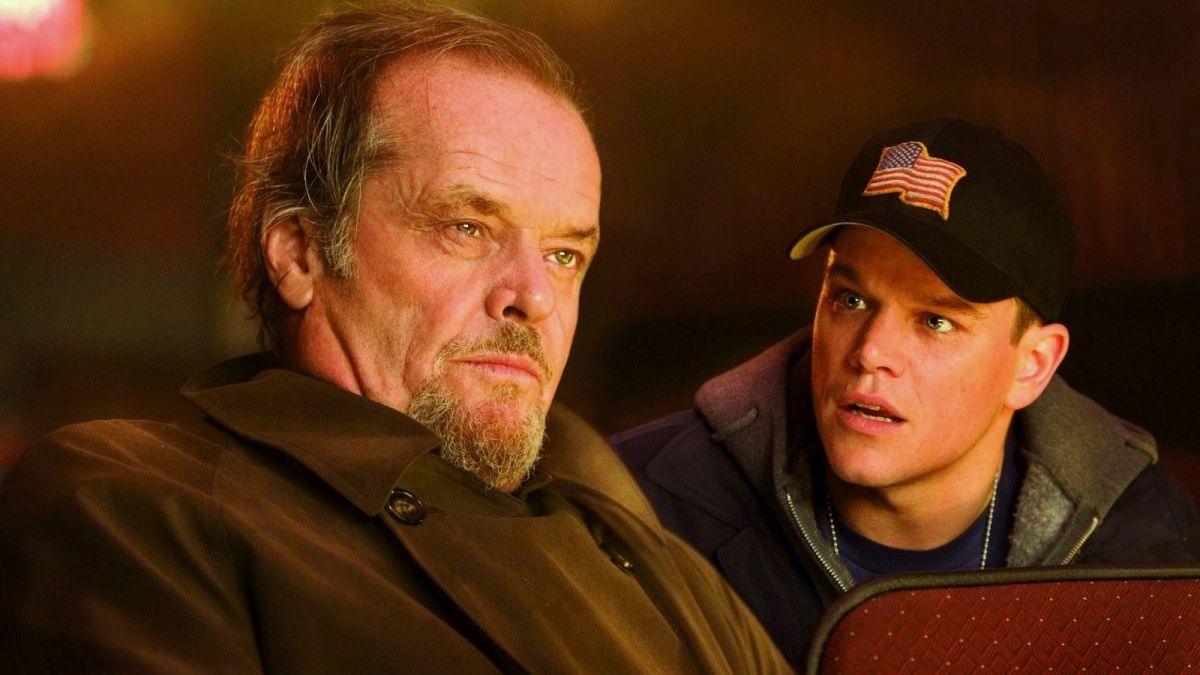
The Departed is rife with beatings, knifings and gunplay, all arising from confrontations between volatile characters. The story is set in South Boston, where the police are waging a campaign to stamp out an Irish-American crime syndicate led by the ruthless but cultured Frank Costello (Jack Nicholson). Young cop Billy Costigan (Leonardo DiCaprio) is assigned to go undercover and penetrate Costello’s gang, and quickly gains the older man’s trust. Meanwhile, hardened criminal Colin Sullivan (Matt Damon) has infiltrated the police department as an informant for the mob, and rises rapidly in the Special Investigation Unit. Both men gather inside information for their respective sides, but when the cops and criminals realize there are moles in their midst, Costigan and Sullivan find themselves in predicaments that are increasingly perilous — and potentially deadly.

The film is based on the acclaimed 2002 Hong Kong crime thriller Infernal Affairs, directed by Wai Keung Lau and Siu Fai Mak and shot by Lau and Yiu-Fai Lai. (Christopher Doyle, HKSC, who prepped the picture and shot part of it, is credited as “visual consultant.”) Ballhaus says he “enjoyed that film a great deal,” but notes that he and Scorsese took their own approach to the material. “Infernal Affairs is a very fast-moving and stylish picture, but it has a very different style than The Departed. Marty’s version is much more character-driven, whereas the Chinese version, while very good, doesn’t have that same depth. It was good for me to see Infernal Affairs, because it helped me learn what to do and not do in our film. The original is lit very darkly in places and is rather mysterious, which is sometimes good; however, it’s occasionally a bit difficult to see the characters, and it’s also primarily action-driven. Ours also has a lot of action, but we took a more American approach to the material.”
In formulating a visual strategy, Scorsese encouraged Ballhaus to draw inspiration from a number of other films, ranging from the Forties noir classics T-Men and Raw Deal (both directed by Anthony Mann and shot by John Alton, ASC) to modern Asian fare such as the ultrakinetic Old Boy and the neo-noir Bad Guy. “Marty wanted a noir feel, and Alton’s work is really wonderful and atmospheric,” says Ballhaus. “By asking me to also watch those wild Asian movies, I think Marty was pushing me to try something different. I tried to do that, but after a couple of days on the shoot I realized that although the styles of those movies were great for the particular stories they were telling, we were doing an American movie with American stars. In the end, I had to pull back a bit from those wilder styles; I couldn’t go that far with this movie.”
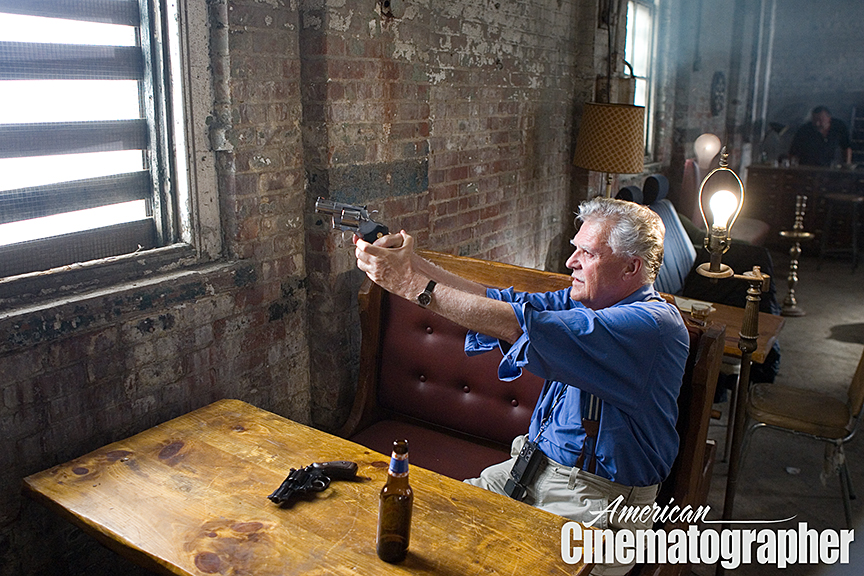
Of course, Ballhaus is no stranger to stylized images. When asked how his relationship with Scorsese has evolved over the years, he recalls working on their first movie together, the gleefully sadistic, surreal black comedy After Hours (1985), in which a hapless New York office worker ventures into SoHo seeking some late-night thrills, only to find himself trapped by a succession of screwball characters. “After Hours was made for $4 million, and it was right down my aisle because it was shot fast and almost entirely at night. Marty wasn’t used to that kind of speed, but I was very glad we could do it that way. We had to complete 16 shots every night, and Marty got every shot he wanted. He was very happy, and at the end of the shoot, he told me the experience gave him a new feeling for how you can make movies. Since then, we’ve collaborated whenever our schedules have allowed it. Over the years, of course, the projects and budgets have gotten bigger, and now we usually have more time in the schedule.”
The Departed is a case in point: the project began principal photography in April 2005 and wrapped five months later, after 104 shooting days. However, editing, as well as reshoots staged in the summer of 2006, pushed the film’s release date to this fall. Ballhaus adds that because the picture was shot in Boston and New York, the company had to travel back and forth, causing additional delays. “Normally you would go to Boston, shoot everything you needed to do there, and then go back to New York to shoot all of those scenes,” he says. “But we had some restrictions because of the actors’ schedules that forced us to commute several times. We had Jack for only five weeks, and it was a similar situation with Matt, who had to go work on another movie. Those restrictions were pretty bad for Marty, because he loves to shoot his films in sequence. He couldn’t do that this time.” A benefit, however, was that The Departed became one of the first feature productions to take advantage of the New York’s recently approved tax incentives.
Most of the movie was shot at real locations in New York and Boston, but a significant number of interior scenes were staged on sets built at the Marcy Avenue Armory in Brooklyn. During AC’s visit to the set in the summer of 2005, the company had set up in South Boston at a triple-decker home in the Dorchester neighborhood. On the top floor, Scorsese, Ballhaus and a skeleton crew worked out a scene with DiCaprio and costar Kevin Corrigan in a cramped kitchen, while outside, the bulk of the company—as well as a group of rubbernecking locals — took cover from a driving rainstorm. A few others gathered beneath a tent to watch the scene unfold on monitors. After many takes, during which DiCaprio offered a variety of different spins on his dialogue, the filmmakers finally emerged onto the building’s front steps, where assistants awaited them with open umbrellas.
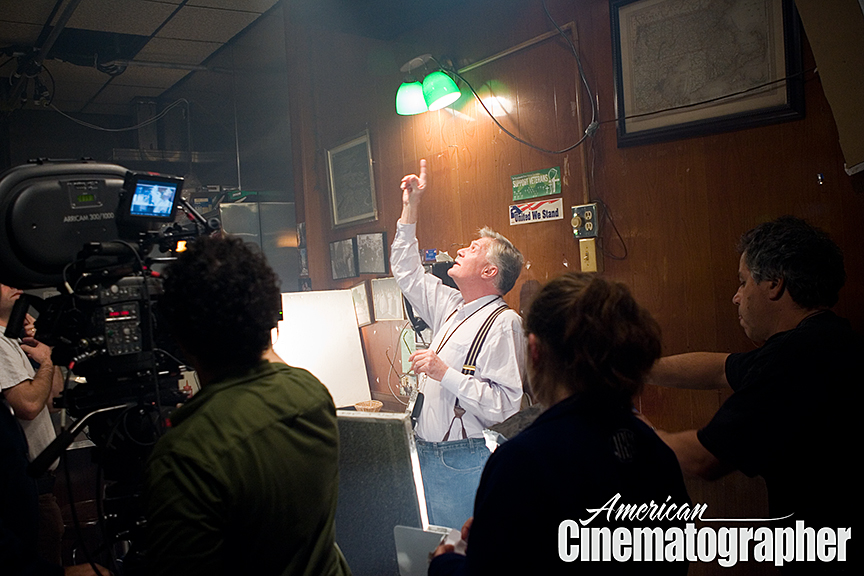
Later that night, over dinner at the Ritz-Carlton Hotel, Ballhaus outlined his general approach to the film’s lighting: “I want this movie to have some darkness, but I want it to be a partial darkness that allows you to see the characters clearly. I’m always trying to break up the light to keep things contrasty and interesting. In general, the light in this movie is more direct, with less bounce light. Normally I like bounce light and soft light, but this movie is more about direct lighting than beauty lighting. The main characters are tough guys who don’t need careful, soft light around them. We’re using a lot of flags and cutters with hard lights.”
Ballhaus shot most of the picture on Kodak Vision2 200T 5217 (day exteriors) and Vision2 500T 5218 (day interiors and night exteriors), and he used the stocks to carefully delineate various characters and settings. “Scenes set in the Boston police headquarters are always more desaturated, not very colorful and on the cool side. For sequences involving Costello, I also want to keep things darker, grainier, desaturated and cool. On the other hand, I shot scenes involving Billy and his psychiatrist, Madeleine [Vera Farmiga], on Kodak [Vision2 500T] Expression [5229], which is softer, less contrasty, and more pastel in its rendition of colors.
“I’m impressed with the new Vision2 stocks,” he adds. “I especially like 5218, which is a great stock. It’s very fast, with nice definition in the shadow areas. What Kodak has done over the last few years is so good that it’s hard to think that in the future, we might not use film anymore. I hope film doesn’t go away too fast.”

The cinematographer’s mandate to “break up the light” is evident during scenes set at police headquarters, the first set built in the Armory. Production designer Kristi Zea worked from photographs of the actual Boston State Police building, which has a stark, poured-concrete aesthetic. The set was built on a platform that stood about 20' off the ground to facilitate the illusion of height through a series of large windows. A TransLite, measuring roughly 40' high by 200' long and lit with Skypans, provided views of the Boston skyline along two sides of the set. To accommodate the contrasty aesthetic Ballhaus sought, Zea’s team made some adjustments to their initial plans for the set’s built-in lighting fixtures. “Kristi worked with us on GoodFellas, and she did a wonderful job on this movie as well,” says the cinematographer. “In following the design of the real headquarters, though, she initially planned to install overhead fluorescents throughout the office set, but those fixtures create a bright overall light that has no drama. Instead, we installed Par cans, which we softened so that we had a direct light with both bright and dark areas. We also did a lot of work with Venetian blinds, using 20Ks coming in from outside the set, or Arri T-12s on the inside, aimed through the office’s glass partitions. That was my approach to the police department, but I tried to maintain that look in the rest of the film as well. I always wanted to create contrast in the frame.”
Gaffer Andy Day, who has worked with Ballhaus on several projects after being recommended by the cinematographer’s son, Florian (also a director of photography), offers further details on this set: “At the real police headquarters in Boston, they have recessed fluorescents in 1-by-4-foot overhead bays with egg crates on them. Kristi replicated those bays, but Michael wanted a more noir look, and he also wanted to be able to control the overhead lighting with dimmers. There were more than 200 holes in the ceiling that we had to fill with some kind of light, and we experimented with a few different types of units. In the interest of the look, convenience and economics, we settled on 1K Par cans with diffusion frames that we could change or remove as necessary. That gave us a lot of flexibility and a good base illumination for the whole set. Because all of the overhead units were on their own dimmer circuits, we could adjust them to create light and dark areas. Our dimmer-board operator, Kelly Britt, is a real wizard. He has a lot of gags, including wireless ones that allow the actors to activate their own lighting cues. I also had a handheld remote-control device that allowed me to stand next to Michael and hit a cue.”

A large “skybox” rig, constructed by key grip Mitch Lillian and his crew, helped provide exterior illumination for the set. Day explains, “Rather than rigging a bunch of Dino lights, we created a big box that gave us an ambient but directional skylight that we could aim through the set’s windows. We started with some Par truss, which is primarily used for rock ’n’ roll shows. The grips then built a lightbox on the front of the truss and ran it around both of the set’s exterior sides. The whole rig was on a chain hoist that allowed us to raise and lower it or tilt it up and down. We could move it in and out according to the shot, and the fact that it could tilt allowed us to aim it precisely. Our main concern was that we had a lot of material to shoot in that big space, and the skybox helped us create some variety in the lighting. We wanted to be able to mix up the look as well as make the lighting appropriate to the time of day. Boston also has a lot of climate changes, so the special-effects guys even set up a rig that could pump out some Boston fog.”
The bulk of the show’s lighting equipment was provided by Panavision New York, but most of the stage rigs were provided by See Factor, a Long Island City rental house that often services theatrical productions. Because the Armory has only a basic power supply, two 10,000-amp Cat Power generators provided electricity. After scenes in the headquarters set were completed, a crew dismantled it and built other sets, including an apartment and the lobby of a converted industrial building. During this phase, the production worked in Boston, where key locations included Costello’s high-rise apartment and a shipyard where a climactic shootout takes place.
Costello’s dwelling, designed by Zea to reflect the character’s refined taste, was a real apartment in Charlestown, near the Navy Yard that is home to the USS Constitution (a.k.a. Old Ironsides). Day says the apartment proved to be “really tough” from a lighting standpoint: “It was a number of stories up in the air, so we couldn’t do anything from outside in terms of sun control. The ceilings were kind of low, and it was a fancy building with a lot of restrictions. Our solution was to use smaller units and light locally.” Ballhaus adds, “I tried to have some dark elements in that setting, because we didn’t want it to be too friendly. Our lighting there was not very bright, but you could see the characters and some elements of the room in the background. We used softer units to match the light that came in through the windows. For example, we bounced some 2Ks into 4-by-4 showcards.”

At the shipyard, the filmmakers went to the opposite extreme, because they faced the challenge of lighting a structure that measured 400 yards long and 100' high. Ballhaus offers, “The scene there involves a secret meeting, and I decided to illuminate the space from outside, as if the light from the shipyard were coming into this huge building. We had one BeBee Night Light set up where the main entrance was, and on the other side we set up lots of Dino lights, maybe 20 of them, coming through the windows. For fill light inside I had two balloons, along with car headlights and lots of smoke. It looked very dramatic.
Another major Boston setting was the Chinatown district, which serves as the backdrop for a lengthy nighttime foot chase involving the two main characters. “Billy follows Colin to a porno theater where he’s meeting with Costello, and then tails him through Chinatown,” details Ballhaus. “But along the way, Billy’s cellphone rings, tipping off Colin that someone is following him.” The lighting for this scene, according to Day, was designed to be eerie and almost hallucinogenic. “Blade Runner may have been mentioned, so there’s a lot of steam and colored light,” says the gaffer. “At one point, the characters are in a dark, unpop¬ ulated alley, and the next moment they’re out on the crowded streets. Marty and Michael wanted that scene to look very otherworldly, and the ambience is very disorienting, with a lot of color and a mixture of light and dark areas. To create that fantastical quality, we used Condors to position some bigger lights gelled different colors, and then we mounted a lot of additional units on walls, on fire escapes and behind crates.”

Back in New York, a key scene involving an exchange of microchips between Costello’s mob and an Asian gang was staged at a large structure in Red Hook, Brooklyn, that once served as a grain depot. “That was a strange location — it was a very big place with a number of empty silos,” says Ballhaus. “There was water on one side and land on the other. Because the scene involved another secret nighttime meeting, I decided to light it mainly from the outside. For the interior of the silo where the two gangs meet, I just used one spotty overhead light, an open 5K pointed straight down to create a hot area between the two gangs that fell off into darkness. Outside, we set up lots of big lights. From the water side, I lit the location with one BeBee light; from the other side, I used a lot of big Dinos to create shafts of light that the characters could move through.” Day notes that the silo proved to be an effective setting, serving as a “giant snoot” for the 5K. He adds that the Dinos, which were gelled with Lee 013, were intended to simulate “the type of big, ugly, sodium lights you might find in a parking lot. We also used that look in the Boston shipyard as a way of tying together our nighttime crime scenes. On the BeBee light, we added Vi CTO to create some color contrast; the result was a kind of yellowish sodium color on one side of the setting, and a bluish look on the other. Michael also occasionally liked to mix in some green, either by using Va or Vi Plus Green gels for tungsten units, or by leaving fluorescents uncorrected or intentionally using Cool White bulbs. You would normally avoid that kind of look on a different kind of movie, but he wanted things to be a bit lurid sometimes.”
To lend subliminal menace and a sense of foreboding to the film’s treacherous situations, the filmmakers borrowed a visual trope from Alton’s work in T-Men, incorporating X-shaped patterns into the lighting, architecture and set design. These crosses, which the crew dubbed the “X motif,” appear whenever a character is in mortal danger. Citing an example, Ballhaus says, “At Logan Airport in Boston, there are these wonderful bridges from one terminal to another, and they have these beautiful X-shaped crosspieces. We have a really intense scene there when one of our main characters is moving down a walkway and passing all of the X shapes. When you see the X, you know it means trouble!” Day elaborates, “Sometimes we’d just throw some light on a wall that the grips would then cut into an X-shaped shadow, sometimes we used a Source Four Leko and actually cut a pattern to create a thin X of light, and sometimes we did it with a gobo on the camera that would create an X pattern. The X motif was something everyone worked really hard to achieve. We even had grips and electricians saying, ‘Hey, we could put an X here!’ Michael was always very excited if someone found another place to put an X. He and Marty did it partially as a homage to the great noir films, and also to create a sense of imminent doom.”

The film’s close-up work involved a variety of techniques. Although Ballhaus felt comfortable using harder-edged lighting on the male actors, he treated Farmiga more kindly. According to Day, this usually meant aiming a Fresnel through Lee 216 or Lee 129, or using Vs or Vi Schneider Classic Soft: diffusion on the lens. (These filters were occasionally applied to shots of Nicholson as well.) In other situations, he says, “we used a variety of units, depending on the situation. Sometimes it was just a Kino Flo, or we might go really hard with a Source Four and cut it right in on a character. Michael’s always big on getting some light in the actors’ eyes, so we often had a small Dedolight by the camera that we’d shutter right in to create a ping in the eyes. When you’re creating a contrasty look and keeping things on the dark side, you still want to see a sparkle in the actor’s dark-side eye. At other times, we might use a Fresnel with little or no diffusion. In terms of lighting, Michael generally likes to work from a motivated standpoint, but sometimes he’ll get impressionistic if it fits the story.”
Speaking to this point, Ballhaus notes that he occasionally took certain characters all the way into silhouette. This technique proved useful for an early scene involving Costello that takes place 12 years before the main period of the story. “He’s in a garage, discussing the differences between gangsters and policemen with some little kids, one of whom is Colin. Because Costello is supposed to be younger, we tried to keep Nicholson in the dark or backlight him. You can still see the outline of his face, though; he doesn’t just become a black blob.”

A longtime user of Arri cameras, Ballhaus employed Arricam Studios as his main units, and he used an Arri 435 for high-speed shots and an Arri 235 for handheld work. A-camera operator Andrew Rowlands, SOC handled the Steadicam work, including an early shot that simulates Costello’s POV as he walks into a coffee shop before shifting to an over the-shoulder angle. “We didn’t do anything on this movie that was as elaborate as our big Steadicam shot into the Copacabana in GoodFellas, but Costello’s POV shot looks really great,” Ballhaus enthuses. He also cites B-camera operator and second unit director of photography Tom Lappin, who supervised a number of nighttime scenes and car sequences, for excellent work.
The Departed was filmed in Super 35mm 2.35:1, which Scorsese and Ballhaus use to protect their compositions during the inevitable reframing for television broadcast. “By framing everything in 4-perf with a common topline, you don’t destroy the whole composition of the image,” he explains, pointing out that the digital intermediate (DI) has eliminated the optical step in post that used to compromise Super 35’s image quality. At press time, Ballhaus was preparing to finish The Departed with a DI — his first — at Technicolor Digital Intermediates with colorist Stephen Nakamura. (HD dailies for the production were handled by Sam Daly at Technicolor New York.)
In a break from his usual preference, Ballhaus employed some very wide-angle lenses on the show. “Normally, I’m not crazy about using extreme wide-angle lenses, but on this movie we used 18mm or even 14mm lenses for certain shots,” he reveals. “We always wanted the images to have some edge, and the wider perspectives helped make the movie look different than a typical, clean, nice-looking picture. We didn’t just use those lenses for standard wide shots, either; we sometimes used them for close-ups to show the room behind a character. We used them in Costello’s apartment a few times, and also during the big, climactic chase sequence, which involves a rooftop and an elevator. Our most common range on the show was about 24mm, whereas normally I like to be more at 32mm. With the bad guys, I used shorter lenses a lot — they’re criminals, after all, so it’s okay for them to look bad!”
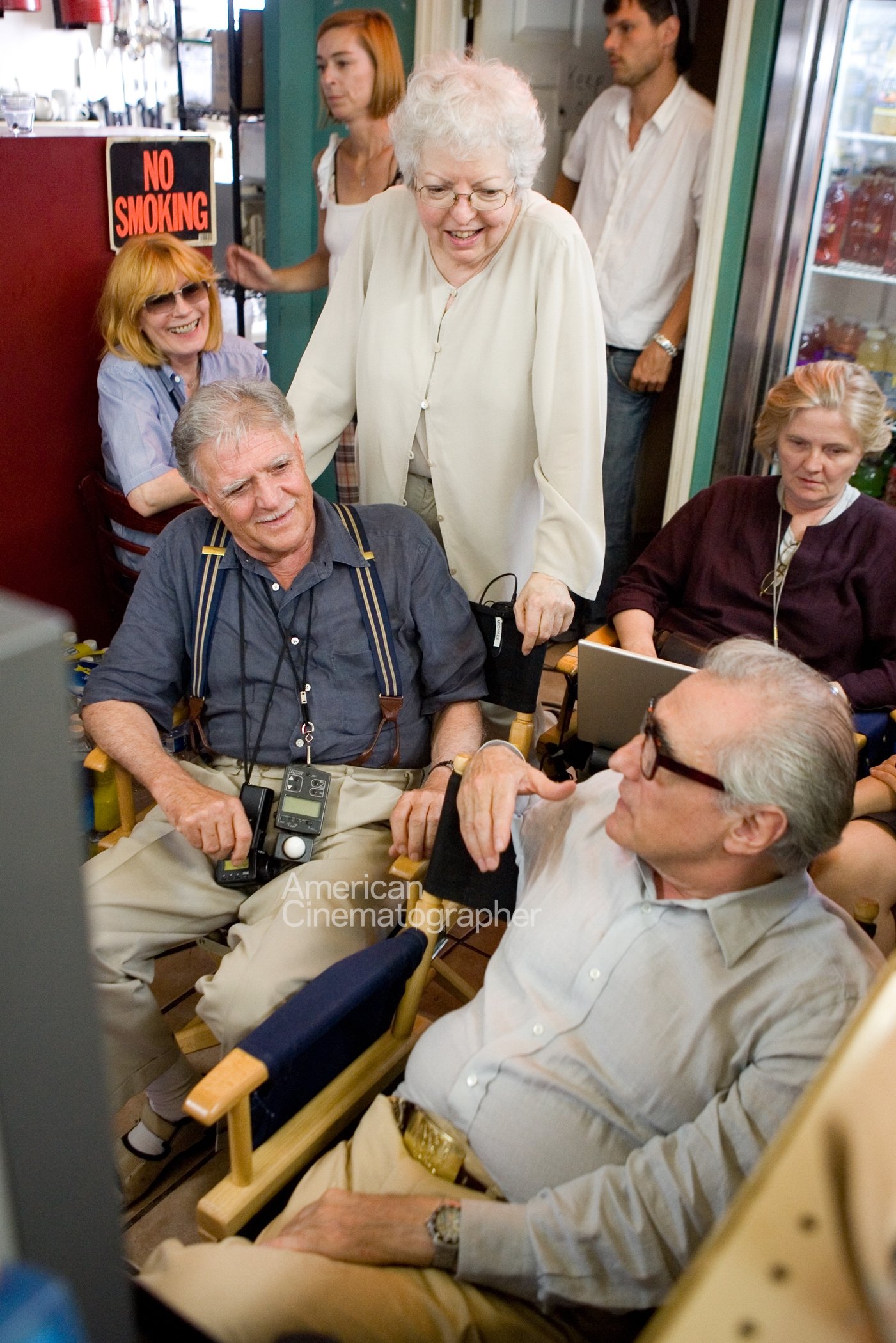
Ballhaus used two sets of Zeiss Ultra Prime lenses on The Departed, along with one set of the new T1.3 Master Primes and one set of Variable Primes. He also employed Angenieux 17-80mm and 24-290mm Optimo zooms, with which he performed the “snap zooms” that have become a Scorsese trademark. Using one of his favorite tools, the Panther dolly, he executed a number of whip-pans, as well as a few of his signature circular dolly moves. However, he notes that many of the snap zooms and the longer dolly moves had to be trimmed from the movie to save screen time. “The cutting style that Marty and [editor] Thelma Schoonmaker used on this picture is very fast and very dynamic. The story moves so quickly that don’t feel the true length of the movie when you’re watching it — when it’s over, you think it was only an hour rather than 2Vi hours.” After a long pause, he laughs and admits, “Naturally, like any cinematographer would be, I’m disappointed that some of the great moves we achieved didn’t make it into the film. The fast editing style is right for the movie, so I’m not complaining, but when you’ve done some nice moves and they don’t make the cut, you feel a little bit sad!”
TECHNICAL SPECS
- Super 35mm
- 2.35:1
- Arricam Studio; Arri 435,235
- Arri/Zeiss Master Primes; Zeiss Variable Primes, Ultra Primes; Angenieux zoom lenses
- Kodak Vision2 500T 5218, 200T 5217, Expression 500T 5229
- Digital Intermediate
Following the original publication of this article, The Departed went on to win four Academy Awards for Achievements in Film Editing - Thelma Schoonmaker, Adapted Screenplay - William Monahan, Best Directing - Martin Scorsese (his first!), and the coveted Best Picture prize. It also picked up a fifth nomination in the form of Best Performance by an Actor in a Supporting Role for Mark Wahlberg.
For more behind the scenes, check out the picture gallery that we published previously.