Universal Translator: Arrival
Bradford Young, ASC helps bring a naturalistic look to director Denis Villeneuve’s soulful sci-fi drama Arrival.
This article originally appeared in American Cinematographer's December 2016 issue. For full access to our archive, which includes more than 105 years of essential motion-picture production coverage, become a subscriber today.
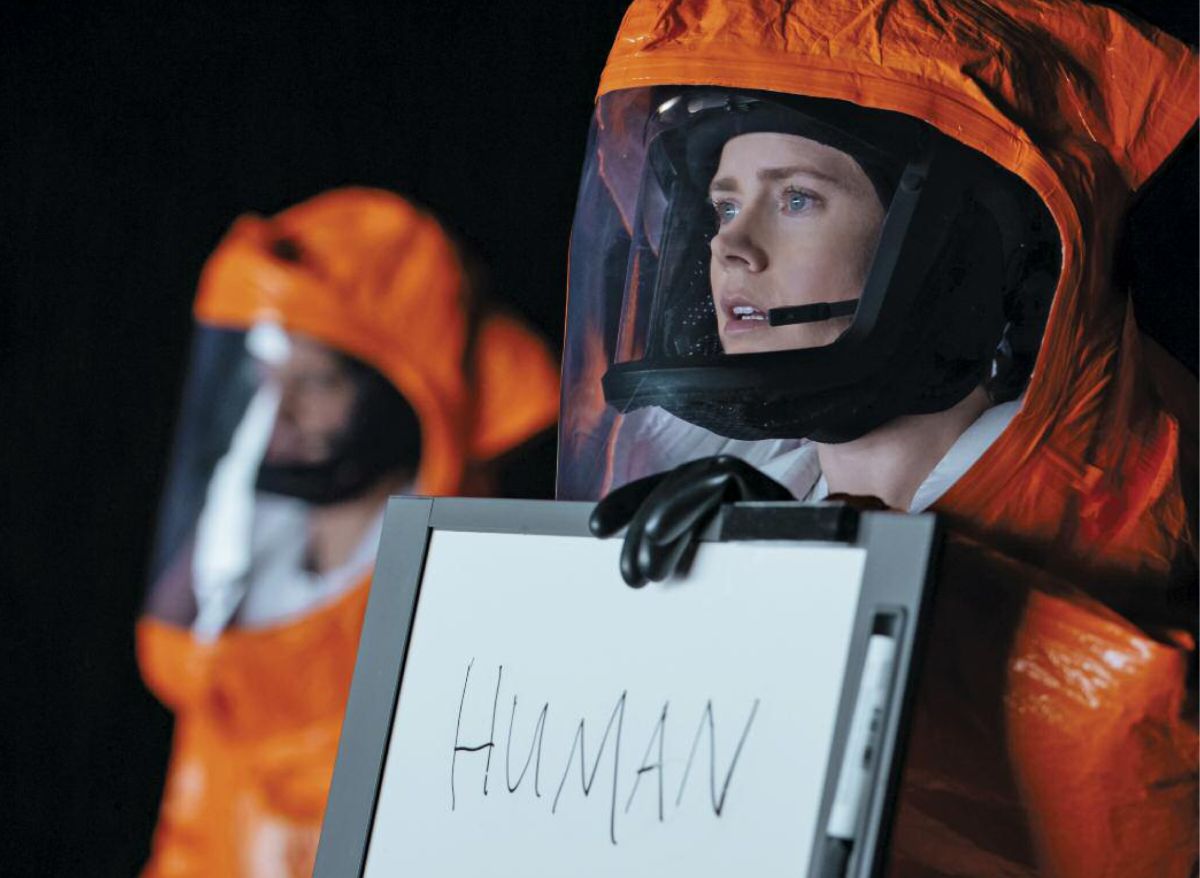
A dozen extraterrestrial spacecraft have landed across the globe in Arrival, a science-fiction epic with a melancholy soul. Renowned linguist Louise Banks (Amy Adams) has been enlisted to serve as Earth’s interlocutor by military-intelligence officer Col. Weber (Forest Whitaker), who has set up a base in rural Montana near one of the hovering vessels. Joined by physicistIan Donnelly (Jeremy Renner), the U.S. team makes its way aboard the vessel, where they encounter two beings who produce mysterious symbols from behind a large, protective, see-through screen. Deciphering the alien messages proves an onerous task, but as the visitors’ ambiguous behavior threatens global stability, Banks must prove that their intentions are nonviolent before it’s too late.
Quebec director Denis Villeneuve became involved with Arrival — based on the novella Story of Your Life by Ted Chiang and adapted for the screen by Eric Heisserer — while shooting the thriller Prisoners (AC Oct. ’13), and later tapped director of photography Bradford Young, ASC to join him on the production. The cinematographer recalls that while shooting J.C. Chandor’s crime drama A Most Violent Year (AC Feb. ’15), he had been advised by gaffer Bill O’Leary and key grip Mitch Lillian, both Villeneuve collaborators, that he and the director might hit it off.
“Polytechnique [shot by Pierre Gill, CSC] and Denis’ other films were already in my creative consciousness,” says Young on the phone from his Washington, D.C., home, two days after Arrival screened at the Toronto International Film Festival. With a laugh, he recalls,“I thought, ‘Yeah, right. One day I’d like to meet him, but I doubt I’d ever shoot for him — he’s way too evolved.’ My agent had asked me what folks I would like to work with as I developed my body of work, and Denis was on my list. Then one day my agent called and said, ‘They just sent us the new Denis film script and would love for you to take a look. ’I said, ‘Come on, man — that’s not real.’ I was pinching myself.”
When he read Heisserer’s script, Young’s excitement continued to build. “It reaffirmed Denis’ brilliance — that he’s a real curator of his artistic practice,” Young says. “That script got deep into my DNA as an image-maker, because it has realism invested in flesh and bone extending into a world of allegory by introducing these unseen beings from afar. I could see how I could offer something.

“Denis and I had a conversation, and there was mutual respect for one another’s films,” adds Young, whose CV also includes Ava DuVernay’s Selma (AC Feb. ’15) and David Lowery’s Ain’t Them Bodies Saints (AC Sept. ’13).“I was moved by the fact that he had seen some of my work and it meant so much to him. I told him I would do anything to work with him on the film, and it went from there.”
In recent years, Villeneuve’s most frequent shooting collaborator has been renowned cinematographer Roger Deakins, ASC, BSC, who worked alongside the director on Prisoners and Sicario (AC Oct. ’15) — and who, at the time of this writing, was assisting Villeneuve on Blade Runner 2049. Young acknowledges that he had big shoes to fill. “Roger’s residue was palpable,” Young says, “but it’s a residue I respect and honor. There’s a high level of consciousness around image, which was humbling. I knew I had to go in with a certain amount of rigor in order to do my best. I had to do my homework. I had to be precise, but at the same time not be arrested by precision and still be free. I felt this was still an opportunity to bring my voice to the conversation.”
During eight weeks of preproduction, Villeneuve related to Young that he and Deakins have a preference for storyboarding — and that they don’t necessarily stick to boards on the day, but value them as a visualization exercise. “I had not done that before, but I was willing to subject myself to the process, and it became an important pillar for us,” Young explains. “Sam Hudecki, our storyboard artist, had worked with Denis and Roger, so he was an integral part of the process. It took a couple of weeks to [familiarize] myself with their way of working in order to feel I could contribute.”
Another way Young contributed was by introducing Villeneuve and production designer Patrice Vermette to the work of Swedish photographer Martina Hoogland Ivanow — particularly her 2013 collection Speedway, notable for its dark, mysterious images. Outlining the movie’s central narrative challenge, Young muses, “How do you create this film that’s about grief, and then [introduce] extraterrestrials who bring enlightenment? Ivanow’s images had that quality — deeply haunting but substantially hopeful. Then it was about making the science fiction seem normal and everyday — as though you’re washing dishes on a humid, cloudy day with soft, atmospheric light, and you look out your window and there’s a spaceship behind the trees. We called it ‘dirty sci-fi.’”

Young adheres to a “less is more” lighting philosophy partly inspired by the work of the late Harris Savides, ASC. “Gaffer Eames Gagnon and I often looked at a handbook of Harris’ quotes from all his movies, and we went back to Birth (2004), which is in the canon of movies I always reference,” he says. “There’s a rumor that in his later films, Harris would only use lamps he could put his hands on. That’s really rigid, but that mantra stayed in my head on this film. So if you see a lamp in the frame, then it’s the only light in the room. And if Amy is standing next to a window, then it’s the window lighting her.”
Nearly 60 days of principal photography got underway in and around Villeneuve’s hometown of Montreal, Canada, in June 2015. Young shot mostly with Arri’s Alexa XT, his go-to digital camera. He captured in ArriRaw, using Open Gate mode, at a 2.39:1 aspect ratio, and recorded to onboard Codex XR Capture Drives. “Using the full width of the sensor allowed us to get a nice, wide frame without anamorphics, and opened up Bradford’s choice of lenses,” offers digital-imaging technician Leon Rivers-Moore. “We shot at ISO 1,280, which is fairly unusual, especially for a visual effects-heavy film. This let Bradford work with less light and lent some texture to the image.” Rivers-Moore, who performed dailies coloring, evaluated images on Flanders Scientific CM250 OLED monitors.
GoPro Hero4 Black cameras were employed for imagery visible on video screens ostensibly used for communication between the landing sites in various nations, while news reports within the movie were shot with Sony’s CineAlta PMW-F55.

On Arrival, Young reunited with Harbor Picture Co.’s Joe Gawler, his regular digital-intermediate colorist. The two are particularly fond of the show LUT they created for A Most Violent Year, so they used that approach as their foundation, although with a cooler overall look. “Everything exists in the toe,” Young elaborates. “There isn’t one real highlight. It’s an aggressively dark LUT.”
Young reports that on this project he operated the camera — and there was nearly always only one. He further notes that “many filmmakers from my generation are saying, ‘I don’t even know where to put the second camera. Let’s just get this frame right and then decide where the camera should go next.’ That’s how we executed the whole film. It’s something Roger and Denis worked into their way of shooting that carried over.”
Young made one exception, however, by putting three cameras to work for an exterior location scene in which Louise and Ian talk on the back of a truck near the base. Although their respective philosophies initially position them as adversaries, the characters have evolved into allies, and the filmmakers wanted to capture their warming relationship at magic hour — which presented a limited window. “We weren’t looking to get more coverage because ‘more coverage is better’ — it was a time variable,” the cinematographer explains. The crew therefore set up a wide shot, along with a side profile of the truck — to which the floating spaceship could later be added in the background — and a two-shot from the truck bed. Close-ups were shot on-stage at a later date.

Young mostly used Camtec’s customized Vintage Series Ultra Prime lenses developed by Camtec’s Kavon Elhami in Los Angeles. The lenses are Arri/Zeiss Ultra Primes, but with recoated glass elements that offer softer contrast and increased flare characteristics. “You get that beautiful creaminess and flare [similar to] a Canon K-35, but with the mechanics of Ultra Prime lenses,” Young notes. He shot them wide open, which had 1st AC Dany Racine, in the words of Rivers-Moore, “pulling focus like a boss at a constant T1.9.”
Young estimates that up to 90 percent of the Vintage Ultra Prime-work was done on the 28mm. If the filmmakers wanted to push in for detail, they would grab a 40mm. “We wanted to shoot the whole film on the 20mm,” he recalls, “but when we shot screen tests with Amy we realized it was way too aggressive on her. It didn’t give us many options to be as close as we wanted. The 28mm got us in a little closer, and we felt that was where she was best represented in frame.”
Emotionally evocative vignettes of Louise and her daughter, Hannah, open the movie and are sprinkled throughout; Young shot these scenes with Arri’s Alexa XT M. The cinematographer held the camera head, which was connected via 20' fiber cable to the body — which, in turn, was mounted to a backpack frame worn by dolly grip Patrice Lapointe, who followed Young. This setup allowed Young to freely track Adams and the actresses playing Hannah at different ages.

After a couple of weeks of shooting, however, it became apparent that these memory sequences were falling short. “Denis and I came out of a dailies screening and it was eerily silent,” the cameraman recalls. “The next morning, I get on the camera truck and Denis is there getting an espresso, and I’m thinking, ‘Something’s not right.’ He said, ‘Let’s talk, man.’ We had a heart-to-heart. ‘This collaboration means so much to us, and this film has so much potential to be special. Let’s be honest, this [approach] isn’t working.’ We decided that those scenes had to be treated very specifically, so we went back and made adjustments. Maybe we needed to be on one lens and get super close.”
Taking the latter notion to heart, “I got so close to Amy on some shots that she was bumping her head on the matte box,” Young says with a laugh. “But she was so cool about it. She understood what we were doing.”
Young decided to work with older Zeiss Super Speed lenses to create a soft, retro look for these home-movie style sequences. He wound up using a 35mm at T1.3, allowing things to fall out of focus and, as he says, “embracing the imperfect.” The only lens filters used throughout the production were NDs.

The memory vignettes were exposed two stops under, while Young was at least a stop under for the rest of the production. “With the Alexa, underexpose as much as you can,” he advises with a chuckle. “It’s super-hard to make that camera go to where you can’t get back information.”
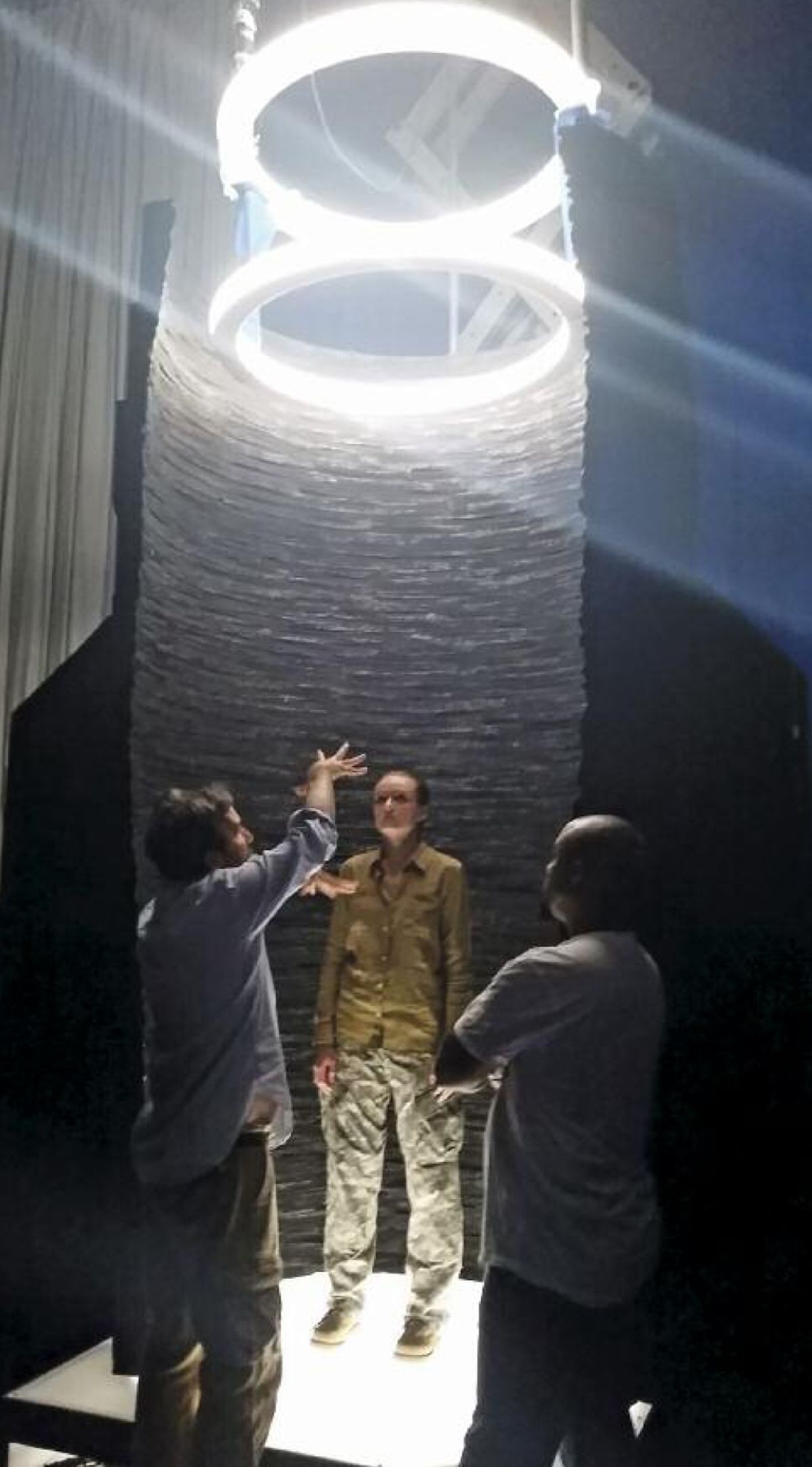
Vermette constructed a massive set for much of the spaceship’s interior “in the old Dominion Bridge Company factory in Lachine [Quebec, Canada], commonly referred to as ADF,” reports Rivers-Moore. The set included an enclosed 150' tunnel — which, in the movie, extends vertically from the bottom of the ship to its center. Weber’s team enters via scissor-lift and then scales the tunnel’s anti-gravity walls, which then open out into an 80'x70' chamber. It is here that the aliens, semi-shrouded in atmosphere behind the main chamber’s large enclosure screen, greet the humans. Bluescreen was placed only at the tunnel opening for extension and to show the ground beneath the vessel. “It was a dream to have an actual ceiling on a set that huge, with real movable walls and floors that had the scraped texture of pumice stone, ”Young says. Additional spaceship interiors were captured at Mel's Studios in Montreal.
It was decided early on that no lights would be built into the ship walls. All illumination for the chamber and tunnel came from the screen, behind which the CG aliens appear. “It was a wonderful opportunity for me to keep doing what I’m doing, which is trying to figure out ways to make single-source lighting bigger, softer and better, ”Young says.

The chamber’s source lighting was provided by 32 Mac Tech 960LS LED Sled fixtures — each containing 24 4' daylight tubes — positioned on trusses behind the screen. “In prep we talked about the fact that it’s a spaceship, so we should try futuristic, cutting-edge lighting,” explains gaffer Eames Gagnon. “So we said, ‘Why don’t we use LEDs?’ It’s the new generation of lighting.”
The screen was formed from a massive 72'x40' seamless bleached muslin infused with fire-retardant cotton that functioned as both a practical set element and as diffusion. For a scene in which Louise brazenly removes her Hazmat suit and greets the aliens by placing her hand on the screen, the crew threw up Plexiglas to give her something firmer to touch. Additionally, they placed Full Grid Cloth directly on the lights and another 72'x40' Full Grid on a truss 6' from the screen for three layers of diffusion. “You could go up close to that screen and put your hand in front of your face, and it was still shadowless,” Gagnon submits. “It was beautiful.”


The lights were controlled from a dimmer board. When the actors were at the front of the tunnel, all of the lights would be up at 100 percent, and as they neared the screen, the output was dimmed down to 20 percent. “We had hard, super-sharp light when they enter the tunnel, which gave us lots of opportunity for falloff and to play with contrast and no fill,” Young says. “As they enter the chamber, metaphorically it opens up, becoming gentler and more delicate. It was difficult to figure out how intense the light should become as we got closer. Those are the challenges when you have a structure bending light in a particular way.”
Most shots aboard the alien craft, including close-ups, were taken via crane and remote head; the occasional dolly work for these sequences became high-maintenance maneuvers, with massive rubber mats laid down to protect the silicon floor. The majority of the rest of the movie was shot on a dolly with an Aerocrane Jib Arm and remote head. “With the dolly work, we were trying to be more procedural and methodical, so we would have small, delicate moves or none at all,” Young says.
Steadicam shots were incorporated very specifically. Peter Wilke came in to operate for a couple of days on scenes in the university where Louise teaches, and Frédéric Chamberland handled the rest. The longest Steadicam shot has Banks — after arriving at the base and seeing the spaceship for the first time — entering a busy, computer heavy military tent in which personnel scramble about. Here, the wandering camera was employed to evoke Banks’ disorientation.
While naturalism was nearly always the goal, Young acknowledges that he embraced a “movie light” look for one key sequence early in the story, when Weber lands a helicopter on Banks’ lawn in the middle of the night. The helicopter is first seen approaching outside Banks’ window, flooding her bedroom with light. She runs to the front door and opens it to see Weber, a shadowy figure with the chopper glare in the background.


Villeneuve came up with the idea of tricking the viewer into initially thinking the lights were from a spaceship. Shooting at a lakefront home on Cadieux Island, the crew had to carefully coordinate the helicopter’s position with visual-effects supervisor Louis Morin, since Whitaker had a large bluescreen behind him and the chopper was a digital element added later.
“I put in 7K and 4K xenon searchlights that I could pan in,” Gagnon recalls. “We didn’t have a lot of backspace, because there was a tree 20 feet off the front door and we had to go in front of it. Then Brad was looking at the setup and it didn’t look right for him, so we switched it.” In the end, they opted to push light into the house from a couple of Arri M40s deployed on dolly tracks to enable minor adjustments. Meanwhile, three Solaris LED SoLED strobe lights and three Martin Atomic flashes provided a flashing effect on Adams.
For daytime shots in the house — seen at the beginning and end of the movie — the sun was the only light source. Blacks were placed in every out-of-frame corner to create contrast. In the glass-heavy cottage, a window on one side of Adams would be left wide open as a key, while on the other side, a tiny square of light would be allowed to pass through for fill.
Gawler performed the final grade at Mel's in Montreal over the course of two-plus weeks, coloring DPX files with Blackmagic Design DaVinci Resolve 11 on a Linux system. Joe Walker edited the movie on an Avid, with the post house providing him with 1920x1080 DNxHD 115 files letterboxed to 2.39:1.

Since Young’s wife had a baby on the way, he and Gawler began a first pass early on, before picture was locked and most visual effects were finalized. “Joe Walker and Denis came in to review,” Gawler says. “They were happy with the overall mood but had specific notes to help emulate a more saturated, dreamy look in the memory scenes with Louise and her daughter.” Gawler further recalls that he and Young referred to Jean-Pierre Melville’s 1969 World War II drama Army of Shadows “to calibrate our eyes to a muted palette.”
Some of the greatest DI challenges related to the extraterrestrial visitors. “The aliens appear in a misty environment, and for much of the film remain mysterious and barely visible,” Gawler explains. “We had to work closely with the visual-effects team to make sure we could see just enough — but not too much — through the mist. Sometimes we were able to achieve that by adjusting the color, and other times the visual-effects team would make subtle adjustments.”
Throughout production and post, Young found Arrival to be an invaluable learning experience. Indeed, this foray into science fiction readied him for his next project: the much anticipated — and currently untitled — Han Solo Star Wars film directed by Phil Lord and Christopher Miller. To prep for that project, Young has decamped to London for a year.
Young advises that whenever cinematographers feel unsure of whether or not they are doing good work, they should have faith in the process and keep at it. “I was very worried,” he admits. “I wanted to do a good job for this filmmaker whose work means so much to me. It came later. After four weeks of shooting, I pulled up a shot for reference and thought, ‘Oh, that’s interesting.’ The film grew on us. And when we walked out, we believed we’d done our best.”
TECHNICAL SPECS
- Digital Capture
- 2.39:1
- Arri Alexa XT, XT M
- Camtec Vintage Series Ultra Prime, Zeiss Super Speed